
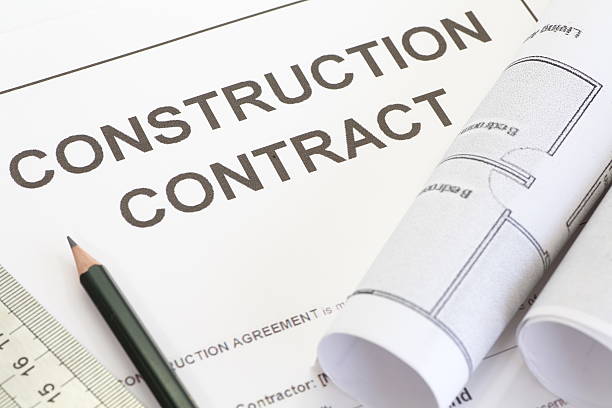
It is crucial for those who enter in any major economic transaction to have contracts written down. This is especially important when it comes to construction projects, which are by nature, complex. A contract for the construction project outlines the obligations of both parties to each other, and also determines how risk will be divided or split on the project.
The Value of Having a Written Construction Contract
A construction contract doesn’t require a reduction to written form in order to exist or function. If two parties are in agreement to perform construction work and the builder starts the work, it is an agreement for construction regardless of whether or not the contract is written and the parties have signed it.
The main difference between a contract written and one that’s not the terms that govern or define the agreement of the parties. If a contract is properly written contract, the written conditions are clearly defined and carefully define the parties’ understanding as well as their expectations and their respective obligations and risks. If a contract is simply verbal it is not written agreements and the terms which govern are defined through conversations or correspondence regarding negotiations (and in the event of dispute, the parties are likely to not be able to reach a consensus on what these discussions were) and the manner of the contract’s execution (i.e. what was the manner in which the parties carried out the work prior to the occurrence of a dispute) as well as the limitations on default rights that are imposed to the contract by law.
One of the major issues faced by non-written contracts is that each person’s memories of the contract change in time, especially when the need for dispute arises. In addition, some people just untruthful regarding the contract’s terms when disputes arise. huge amounts of money are at risk, and a memory differing from (or that is not completely consistent to) “the truth” will enhance their position. This issue can be prevented by drafting a contract.
There are many other advantages to an agreement in writing for construction projects. Even when you and your partner “trust” each other, the written contract will provide an outline from the beginning of the project detailing how both parties will work together to complete the project. This will ensure that the project can run without a hitch and minimizes the possibility of having fatal issues. In the absence of a written roadmap each of the parties could have certain expectations about what the agreement is about or how each will act in certain situations. The assumptions made are typically wrong and could be disastrous to a project.
Written contracts can also provide guidance to the parties or even make them follow reasonable business practices as the rules will be clearly stated in a written contract that has been carefully drafted and will become the norms of every party. This is known in”channeling. “channeling function.”
Another use of channeling is that the construction contract is well-written and requires the parties to think about and discuss issues they might not think about at the start of the project, but which typically arise in the specific kind of project and could be a significant issue during the course of the project.
In the event that there is an issue, particularly when the dispute is resolved at the level of litigation, then the more of the terms which have been reduced to a written agreement, the less could be in fact disputable. This will result in the most efficient, or at the very least more cost-effective solution to the disagreement because there are fewer disputes to fight about.
Default Provisions in the Law
If a contract isn’t written down (if the contract is in writing or verbally, remains in silence on the issue) the law can provide an default clause if there is an issue. By reducing these terms in writing, parties will be able to determine how an issue is dealt with and avoid having a default clause applied to them that isn’t favorable to their particular position.
If the law gives an default clause in many situations (but not always) the term or requirement is able to be changed by parties in their written agreement. Modifications must in most cases be written and be executed by the two parties. In a few cases, the law requires that the change be made in writing but also that certain (sometimes called “magic”) words be utilized. A well-written contract should include the “magic” words.
However, certain legal requirements can’t be changed by a agreement, even the written version. A good example of this would be the law of limitation,, which determines the length of time a party can have when a dispute arises in order to file a lawsuit in the court. In general it is the case that participants to the contract are able to reduce the time frame (down to one year at a minimum of generally not less than a year) however, they are not able to extend the time period.
Risk Shifting
The effect of an economic contract can be to transfer or assign risk. As an example the construction company that signs the terms of a contract with a construction materials provider to purchase two-by-fours at a specific price for a date in the future shifts the risk to the seller-supplier that the cost of two-by-4s will increase between now and the date that is set to purchase. The builder-buyer also accepts an obligation to ensure that cost of two-by-fours will drop.
Each provision in a contract for construction can be seen as a means to transfer or distribute an identified risk. If the construction contract is based on building a construction structure in exchange for the payment of a fixed amount, then the builder is responsible for the risk that events beyond their control could result in the costs of the construction project to be higher than the amount of that fixed cost, decreasing the builder’s profits, or even resulting in loss. In addition the owner is responsible for the risk that any force outside of the control of the owner will result in the costs of building to be much less than that which was planned or anticipated by the parties when the contract was signed which could result in a bonus profit for the builder.
There are a myriad of risks, other than price, that could be assigned through a written construction contract. It is essential to recognize that risk doesn’t require a complete allocation to one person and the opposite. In a typical construction contract the risk is divided so that it is assigned or shared to one party only until the point at when the risk will be divided or assigned again to another party.
Cost-plus contracts that guarantees a maximum amount is an example. The homeowner is liable for the risk of cost overruns, up to the price that is guaranteed. If the maximum price guaranteed exceeds the guaranteed maximum price the risk or burden of overruns back to the contractor for each dollar over the maximum price guaranteed.
Other risks that could be defined by a properly-written construction contract, and the ways they deal with the risk are as follows:
- Time. If a project’s completion is delayed who will suffer the associated loss, and in what amount and how will the loss be accounted for.
- Design Issues. If there is an error in the design the company will be accountable for resolving the flaw and to what extent.
- Acts of God / Damage to the Work / Effects of Weather. In the event of the occurrence of an “act of God,” like a storm that is severe which causes delays or damages to the work, who is accountable for the losses.
- Funding. If there is a delay to the transfer of funds needed to complete the project, for example an inability to pay the lender, who will be accountable.
- Regulatory Risk / Approvals. If the government is unable to obtain the required approvals or issue regulations that require changes in the performance or design for the undertaking, who is accountable for the cost resulting.
- Concealed or Unexpected Conditions. If there are circumstances during the project that are unanticipated, like soil conditions which will not be able to be able to support the construction without substantial or costly, further work, who is accountable for addressing the issue, and in what degree.
- Damage to Third Parties / Indemnity. Who will be accountable for injury or damage inflicted on third parties (i.e. the ones who aren’t a part of any contract that relates to the project being discussed) and in what way.
This list isn’t exhaustive however, and in the paragraph below, we will discuss the key elements of construction contracts, you will find other terms that are commonly used in construction contracts, where risk allocation is also appropriate.
Parties to a Construction Contract
In the case of a large-scale project it is possible to have generally several contracts at a moment. Most obvious and popular is the one with the developer (or the developer) with the general contractor (or builder). In addition, if there is a design professional involved, there is an agreement between the design professional as well as the proprietor (or as is becoming more frequent and increasingly common, between the designer and the builder in the context of design-build agreements). If the builder uses subcontractors instead of self-performing everything (the first being far more frequent) there are subcontracts between the builder and subcontractors (called “first-tier subcontractors”) as well as additional agreements between first-tier subcontractors as well as their subcontractors in the second tier and vice versa.
Suppliers are in the role as subcontractors in this arrangement and there is likely to be a supply contract (sometimes just an order for purchase) between the contractor and the supplier or subcontractor who the supplier has a relationship with. If one party must obtain or carry insurance, the insurance is another type of contract which is applicable on the specific project. Similar to any performance or payment bonds negotiated from subcontractors or contractors are contracts that also apply for the construction project. Therefore even a small construction project could have multiple kinds of contracts for construction.
Key Elements of a Construction Contract
It’s impossible to mention every detail that must be included in a construction contract in every situation. However, each construction contract should address the following issues:
- Price, which includes whether it is calculated as a fixed-fee or cost plus cost plus with a guarantee maximum price;
- What changes in the nature of the contract, work duration, or contract price will be dealt with (change the nature of work, contract time or price);
- The sequence of events and triggering events;
- The date of the performance of every step of the contract
- If delay damages are assessed in relation to delay in completion, and in the event that they are assessed, will they be deemed to be real damages, or as liquidated (an agreed-upon amount) damages;
- Certainties, including whether or not performance and payment bonds are required;
- The conditions and terms of any performance or payment bonds;
- Warranty obligations;
- How notices between Parties will be dealt with
- How disputes between parties will be dealt with or handled;
- What way liens related to projects will be treated or canceled;
- The manner in which interim progress payments can be disbursed and requested and what conditions must be met in order to trigger an award;
- Insurance, including which individuals will be obliged to be insured policies, what events are covered by insurance and what are the parties’ rights to bring an claim against the policies of insurance held by the other party;
- What will happen to the project should a major dispute that occurs during the course of the construction process;
- Termination and firing provisions define how defaults are dealt with as well as,
- What items in the contract will be deemed allowances (items which owners are allowed to choose within a budget) and the manner in which allowances will be dealt with.
Even this list isn’t exhaustive.
Consistency, Flow Down, and Tiers
One of the most important aspects to consider when working on construction projects that involve multiple contracting parties is ensuring that the various contracts are compatible with one another, including the provisions that flow downwards from the higher-tier contracts. For instance, a general contractor-subcontractor contract will frequently have provisions that “flow down”– meaning the provisions of the prime contract between the owner and the general contractor will apply to the subcontract. These provisions must be carefully written and, if a contract is subject to these provisions then it must ensure that it has a copy the contract that is which is being flowed or applied or otherwise. Otherwise, the contracting party is committing to certain terms and conditions of the contract that it hasn’t been privy to.
A contracting party must consider the way in which claims from the other parties are handled even if there isn’t a formal contract between the party and the other. For instance, what happens occur between the builder as well as the owner if the neighbor of the owner claims that the builder damaged the neighbor’s property during work on the property of the owner? In this case, there are often provisions in construction contracts that deal with defense and indemnity.
Industry Forms
Standard industrial forms are frequently utilized to draft and prepare of contracts for construction, specifically for big projects. The most popular forms used are those developed from The American Institute of Architects (“AIA”) and ConsensusDocs. At one point, there was a time when the Associated General Contractors of America had its own set of forms, but they have since been integrated into ConsensusDocs.
When utilizing industry forms It is crucial to be aware of how the various forms for different contracts interconnect and are in sync. For instance an AIA model for an architect-owner type contract requires that you use an AIA template for an contract between the owner and contractor. So, if you opt to choose to use a typical owner-contractor agreement, you must be certain that an existing contract from that same supplier can be used to create the owner-architect agreement. Also, any modifications made to an existing owner-contractor must be considered when writing the owner-architect agreement and the reverse is true. The same consideration applies to modifications of contractor-subcontractor subcontracts, subcontractor-subcontractor subcontracts, and supplier purchase orders.
Conclusion
Every construction project of any kind requires a written agreement or contracts. You should seek the advice of an attorney to determine if you’re planning to enter into a contract to conduct any construction project.