
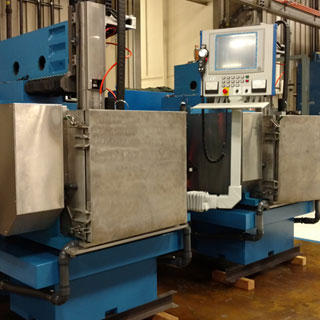
EDM is used frequently in tooling and molding processes across various industries such as aviation, aerospace, and gas turbines. It uses thermal energy to remove excess material and create the desired shape. Manufacturers often use EDM to replace traditional machining methods. EDM can be applied to any conductive material and allows for high precision.
EDM is similar to manufacturing processes such as laser cutting. EDM doesn’t require or attempt to use any mechanical force to remove debris. This is in contrast to traditional machining processes, which rely on actual cutting tools coming into contact with the object.
Hi-Tek Manufacturing helps you to find the most effective way to work with hard metals. We use unique methods that are often ineffective or not efficient.
What is ELECTRICAL DISCHARGE MACHINING?
EDM, also known as spark machining or wire erosion, spark sinking, spark eroding or spark machining, is a manufacturing process that uses sparks to produce desired shapes. This machining involves the removal of material from the workpiece by a series of repeating current discharges between different electrodes. The dielectric liquid that separates the electrodes is applied to an electric voltage. EDM machining can only be used with electrically conductive materials.
The workpiece electrode is an electrode that can change its shape to suit a specific purpose. Sometimes it is simply called the “workpiece” or “anode”. The tool-electrode is also known as the tool, “cathode”, or “electrode”. The EDM process involves changing the shape of the workpiece-electrode using two electrodes. However, they cannot make contact with each other. Instead, they must spark. This can take between 8,000 and 12,0000oC.
The voltage between the electrodes increases, and the intensity of the electric fields in the space between them surpasses that of the dielectric. As a result, current can flow freely between them. This phenomenon is similar to a condenser or capacitor being broken down. This is also called the breakdown voltage. It is the voltage at which insulation becomes electrically conductive.
This is the voltage at which the diode can conduct in reverse. This is the process of removing material from the electrodes. When the current stops (or is manually stopped depending on the generator), a new liquid dielectric is usually conveyed into inter-electrode volumes to remove solid particles while the dielectric’s insulating qualities are being restored. Flushing is the process of adding liquid dielectric to the inter-electrode volumes. A current flow also restores the difference in potential between the electrodes to the level it was before the breakdown. This allows for a new liquid-dielectric breakdown to take place.
WHAT HAPPENS IN EDM PROCESSING?
EDM uses a pulse-form potential difference to apply a voltage across the tool and workpiece. A small gap between them must be maintained, and they must also be electrically conductive. The tool and the workpiece are then placed in a dielectric medium. This can be either kerosene, deionized or water. As the potential difference is applied, electrons move towards the workpiece. The electrons move from the tool towards the workpiece and collide with molecules in the dielectric medium.
The collision of electrons with a molecule results in it being converted into ions. This increases the concentration of electrons between the workpiece and the tool. Plasma is created when an electron and ions travel towards each other. A plasma is an electric current that is formed between the tool and the workpiece. The kinetic energy of electrons and ions striking the workpiece and tool changes to heat energy. At 10,000o C, this high heat vaporizes or melts the material.
When voltage is reduced, current ceases to flow between the workpiece and tool. The molten material in the piece is flushed out by the dielectric medium, leaving behind a crater.
WHY IS EDM PROCESS SO IMPORTANT
EDM is a valuable tool and dies component that has been used in mold-making for many years. EDM has become an integral part of creating prototypes and production parts.
It is essential to develop precision instruments for certain industries, such as aviation, electronics, and turbine engines. These instruments must be able to work with hot gas path components and blades. They have to withstand extreme conditions and keep the numbers low. It is possible to create complex contours and cavities in hardened steels and other exotic metals with good EDM machining equipment.
EDM – THE MAIN PARTS & EQUIPMENT REGULARLY USED IN EDM
These are the primary components of an EDM:
- A DC pulse generator provides power for the machining operation.
- A voltmeter can be used to measure voltage.
- An ammeter measures the flow of current and checks it. Operators may not be capable of determining whether current is flowing without an ammeter.
- The tool is connected with negative power sources instead of the workpiece connected with positive power sources. The fluid flows to the tool from the filter. When the power supply between the tool and the workpiece increases, sparks are generated, and the machining starts.
- The property of the dielectric fluid is similar to insulation. This is because no current flows between them. The dielectric fluid will be ionized as an ion. This acts as an aid between the tool and the workpiece. The fluid returns to its original position when the power supply is cut off.
- The pump pumps fluid from one source to another and flows through the filter.
- To filter out different particles, a filter is used. The filter removes dust particles from the object before it is sent to the tool for operation.
- A controlled feed is a feed that is provided for the operation.
- Fixtures keep the table in its place.
- A table supports and stabilizes the workpiece.
ELECTRICAL DISCHARGE MACHINING – THREE TYPES
EDM is the solution to high-precision, challenging machining applications that require precision and are not possible with conventional metal debris removal. The dielectric fluid acts as an electrical insulator until enough voltage is applied. After that, it becomes an electrical conductor. The spark discharge causes the workpiece’s final shape to be eroded.
Although the EDM process can be unique and unconventional, there are many ways to achieve the desired results. It is important to recognize that there are many others, even if one type does not work. Hi-Tek uses three types of EDM.
WIRE EDM
Wire EDM (or sometimes WEDM) was created in the 1960s and 70s as a new way to make dies from hardened steel. This method of EDM uses a thin wire as an electrode. It moves in a controlled pattern that causes sparks to form between the wire and the workpiece. Wire EDM is also known as spark EDM. It is an electro-thermal production process that uses a thin, single-strand metal wire, typically made from brass. Deionized water is used to conduct electricity. This allows the wire to heat up the electrical sparks and cut through metal.
The wire EDM machines use constantly moving wire to provide a new discharge path.
WEDM, also known as the “cheese-cut” EDM method, works well, but it has one major limitation. The wire must pass through the workpiece completely, making it an essentially 2-D cut within a 3-D part.
WEDM is able to machine precision parts and complex parts in aviation, power generation, and turbines that rely upon hard conductive materials. This makes it an ideal fit for Hi-Tek’s clients.
Hi-Tek started its wire EDM processing operations in 1984. Hi-Tek’s WEDM capabilities have been continuously improved and expanded since then. We can handle up to 51 inches by 39 inches by 20 inches with our WEDM equipment. To produce a wide range of shapes and geometries, the department has (8) CNC-controlled 4-axis and 5-axis machines. Our department is responsible for producing electrode holders and cross-sections that are used to evaluate brazing.
PLUNGE EDM
The EDM machines are conventional EDM, sinker EDM, and ram EDM. They use spark erosion through electrical discharges to cut or drill metal or graphite. The heat generated can reach temperatures up to 20,000 degrees. If the material has conductive properties, it can be punched or drilled using an ordinary EDM. Plunge EDMs, however, use a dielectric liquid. The project is submerged in the dielectric fluid to provide insulation while the electrode and project are charged.
A power supply is connected to the material being worked on. An electrode is then used to create a conductivity path and cut the material into desired shapes or patterns.
The erosion results from the current produced by the electric current, and there is no contact between the electrodes and the workpiece. This is done in a dielectric fluid that allows electricity to flow. It is used to remove any debris and ensure clean edges. Plunge EDM can be used for keyways, washers, scientific research apparatus, injection mold tooling and micro-hole drilling.
Hi-Tek’s wide range of plunge EDM Machines can handle parts up to 48″ x 29.5″ x 20″. The EDM equipment can be used in various axes, from manual 3 to 6 and CNC 6. Many of these machines can be equipped with CNC electrode changers. Hi-Tek was established in 1980. Since then, the range of plunge EDM machines has been greatly expanded and updated. Each year, millions of holes, slots, and grooves are produced using our plunge EDM machines. Our plunge EDM machines are used to produce these products.
FAST HOLE EDM
One of the most recent EDM technologies, fast hole drilling, is designed for fast hole making. Hi-Tek keeps up with the competition by building and designing fast-hole drilling EDM machines. These machines are superior to those available in the market. Hi-Tek can design and build many sizes and configurations to meet the needs of each customer. Precision holes can be EDM-drilled up to 70% faster than conventional methods, regardless of metal and hardness.
- 6-axis machining capabilities
- Size of hole: 008″ to 0.25″.
- Parts up to 1000 lbs
- Speed drilling – long runs.
Hi-Tek is available for both short- and long-term contracts. We drill holes from.006″ to.200″.
Our key industries include aerospace, tool and die, medical, power turbines, automobile, military, and automotive. This process allows us high tolerances on complicated patterns and geometries. Plunge EDM is not like WEDM, which uses a pre-drilled hole to feed the wire through the process. The most popular plunge EDM electrodes are machined copper and graphite and tungsten, tungsten, and brace.
EDM ADVANTAGES IN OVERCOMING TRADITIONAL MACHINING SYSTEMS
EDM has many distinct advantages over traditional machining processes, especially for industries such as aviation, marine and land-based turbines. These are just a few benefits:
- It can be used on any hard material, even if it has been heat-treated.
- It is possible to create and reproduce complex shapes using a tool.
- EDM can achieve a high accuracy of.005 mm.
- Economically feasible high-quality surface finishes up to.2 Microns
- It can be used on any type of electrically-conductive material.
- Proper cooling and lubrication process ensures a longer tool life.
- It takes less time than traditional machining processes.
- It is easy to create a hard, resistant surface on dies.
- This process is free from mechanical stress because there is no contact between the workpiece and the tool.
WHY USE ELECTRIC-DISCHARGE MACHINING
EDM is ideal for dealing with one of the most important issues in manufacturing, and that is dealing with objects. The key issue is hardness. Metal workpieces must be made using special steel grades that can be hardened by annealing treatments that alter the physical and chemical properties. This enables it to become more malleable, making it easier to shape, and so on.
After the desired shape is created, it can be machined using any one of three types of EDM. The parts can then be hardened with one or more heat treatments. EDM has the advantage of being able to cut hardened materials as well as exotic alloys. It also provides excellent surface finishes, which often results in a lower need for post-processing.
EDM machining offers the added benefit of being repeatable, precise, and predictable. EDM machining can also be done without the need for human intervention, which helps to lower direct labor costs and manufacturing costs.
Secondary processes in EDM are rarely required to remove friction machining. However, it is not common to do so. Because the part is already managed, removing the burr can be a time-consuming and redundant task.
EDM machining offers the most appealing advantage for small and complex parts. They are more difficult to machine, and their geometry changes make them smaller and deeper.